
WASHINGTON 鈥� Local high school students Daiana James and Kyle Fox Shreve are prepping for a major national competition that kicks off this week. But their training doesn鈥檛 involve carb loading, stretching and weight training; for them, it鈥檚 all about memorization and recitation.
James and Shreve compete with poetry, and this week, they鈥檙e headed to the national competition at George Washington University鈥檚 Lisner Auditorium, where they鈥檒l attempt to beat out 51 other high school students from all 50 states, the U.S. Virgin Islands and Puerto Rico for a first-place prize of $20,000.
Both teens never predicted they鈥檇 eventually compete on stage with stanzas and sonnets. It just started with a routine English assignment: find a poem and recite it in front of the class.
鈥淚 reluctantly did it. I did the assignment and I did well, apparently,鈥� says Shreve, a freshman student at Tuscarora High School in Frederick, Maryland.
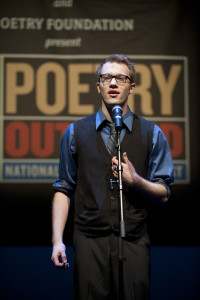
So well, in fact, that he went on to win his school, county and state poetry recitation competitions. Now, he鈥檚 a fan of a subject he never considered.
鈥淚t鈥檚 a very cool thing, poetry. It鈥檚 very expressive,鈥� he says. 鈥淚t鈥檚 been a very surreal experience because I was not expecting to do anything like this going into my freshman year.鈥�
James, a student at Benjamin Banneker Academic High School in Northwest D.C., participated a little more willingly. She describes herself as a bookworm, so when her teacher asked her to participate in the classroom contest, she didn鈥檛 think twice.
鈥淚t was never as issue of 鈥業 don鈥檛 want to do it but I have to do it.鈥� It was like, 鈥極h yea. I鈥檓 getting a grade for this, too? Awesome,鈥欌�� she says. Similar to Shreve, James advanced to her schoolwide competition and then took first place among other high school students in the District.
What does a poetry competition entail?
Preparing for a poetry competition starts with memorization, the teens say. For the national Poetry Out Loud event, which is in its 10th year, participants are required to select three different poems to recite on stage.
They have their favorites, but both James and Shreve try to branch out, too.
鈥淚 hate to be clich茅, but I love Shakespeare. If there was ever a time where I had to do something on the spot, it would probably be Shakespeare,鈥� James says.
When Shreve picks a new poem for competitions (he prefers more contemporary poetry), he immediately grabs a notebook and writes the lines down as many times as it takes until all of the words are committed to memory.

鈥淚 rewrite it to the point that I can say it without even thinking about it,鈥� he says. 鈥淲hen I鈥檓 up on the stage, I don鈥檛 want to worry about what I鈥檓 going to say next; I just want to worry about how I鈥檓 going to say it.鈥�
The competition鈥檚 participants are judged on accuracy, difficulty and delivery, which James says is always the trickiest component.
鈥淭hey say it鈥檚 not like a monologue, you shouldn鈥檛 have costumes or props or make any big gestures,鈥� she says. Balancing emphasis and emotion is something both of the teens have to practice, but James says nailing the delivery is easier when she selects a poem that resonates with her.
鈥淎t the end of the day, if you love that poem, you love the words, you love the message, the rest of it sort of follows suit,鈥� James says. 鈥淚t鈥檚 all about analyzing it, and what connections can you make with these words.鈥�
Over the past 10 years, Poetry Out Loud, which is a partnership between and , has reached about 3 million students in more than 9,000 schools.
Jane Chu, chairman of the National Endowment for the Arts, says the program was started to help students refine skills in public speaking and to spark an interest in poetry. She says it also builds confidence 鈥� a quality Shreve noticed immediately.
鈥淚鈥檝e been told, growing up, that I鈥檓 very shy, and actually when you recite poetry 鈥� you get up there and you feel confident. It builds confidence,鈥� he says.
Of course, the competition鈥檚 winner will also be able to build something else, such as a college fund 鈥� even if the teens would rather spend the $20,000 on something a little more exciting.
鈥淲ill my parents be listening to this?鈥� Shreve jokes. 鈥淥K, yeah, [I鈥檇 spend the money] on college.鈥�


