
WASHINGTON 鈥� When Julius Dupree cycles around the city, people stop and stare.
The 43-year-old looks like any other cyclist. He wears a helmet, a bike jersey and spandex, but his bike sets him apart from the others: it only has one wheel.
鈥淚鈥檓 really an avid unicyclist,鈥� says Dupree, who lives in the Bloomingdale neighborhood of Northwest D.C.
Dupree spends six to seven hours a week riding anywhere from 20 to 40 miles at a time on a unicycle that towers over other bikes. (The wheel on one of his bikes measures at 36 inches.)
Getting up on the bike is no small feat, and staying on is even harder. Dupree mounts the bike from the back: he puts one foot on the pedal and uses the other to propel his body on the seat. Once he鈥檚 on the bike, he has to catch his balance and start pedalling forward.
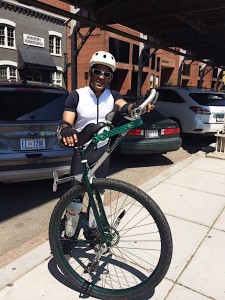
鈥淥nce you learn, it鈥檚 like riding a bike. But it鈥檚 a little more challenging, obviously,鈥� he says.
Don鈥檛 expect to see Dupree doing aerial jumps or juggling while he rides. Similar to traditional cycling, there are several different styles of unicycling. He prefers long-distance riding and touring, mostly because it鈥檚 a great workout.
鈥淭he fitness piece of it shouldn鈥檛 be underscored,鈥� says Dupree, who has been unicycling since he was 12. 鈥淚t鈥檚 a good workout for your muscles and your abs because of the balance aspect of it, your legs 鈥� because you can鈥檛 stop pedaling. It鈥檚 really a challenging workout.鈥�
In fact, on his long rides he burns between 1,000 and 2,000 calories.
Dupree doesn鈥檛 just ride unicycles 鈥� he designs and builds them, too. And later this summer, he鈥檚 launching his custom unicycle line,聽.
He got the idea for the business about four years ago when he took his unicycle in for repair at a local bike shop. It was there that he met Mike Minnery, a welder and artist. Minnery suggested making a few modifications and additions to Dupree鈥檚 unicycle, and Dupree ended up showing Minnery a sketch he鈥檇 made a year before for a bike prototype.
鈥淚 was actually kind of embarrassed about it because I didn鈥檛 want people seeing this prototype because I didn鈥檛 want people to think, 鈥榃ell this guy鈥檚 kind of nuts.鈥� So I hid the prototype under a stack of papers for a while.鈥�
The two ended up building the prototype and named the bike the Shapeshifter 鈥� the first unicycle of Lonewulf鈥檚 line.
When the business officially launches later this summer, Dupree says Lonewulf will focus its production efforts on a universal 29-inch-wheel all-terrain bike. Slowly, he will add more bikes, including one for beginners.
鈥淚 get a lot of people who want to learn how to ride. I see people in the street all the time who are like, 鈥楳an, I like the way that thing looks; that thing looks so cool. Can I learn to ride it?鈥欌��
Dupree says in addition to having beginner bikes, he also hopes to offer lessons to beginners.
The plan is to keep Lonewulf鈥檚 production in the U.S. and to keep the prices in an affordable range. (Dupree says unicycles can cost anywhere from $100 to聽$1,500). He will also sell specialty parts for those who don鈥檛 need the complete unicycle.
In more recent years, Dupree says he鈥檚 seen growth in the sport. In 1982, the was formed, and every two years, the organization hosts the unicycling world championships. There鈥檚 also a community for the Washington area, called , which has a couple hundred members listed on its forum.
Dupree anticipates the sport will continue to grow as people become more aware about the health benefits of unicycling and consider it an option for commuting through the congested city.
鈥淏ike is a great form of transportation as well, I just like the challenge of riding one wheel as opposed to two,鈥� he says.
聽Watch Julius Dupree explain how he mounts the bike, and see him ride in Georgetown:聽


