
WASHINGTON — As it has continued to grow in stature, hype and duration, the NFL Draft has taken on a life of its own as a sporting event.
The process is touted and advertised for weeks in advance, with supposed experts positing their views of the prospective draftees鈥� values rising and falling for any number of reasons. Then, finally, when all the mock drafts and predictions have been made, the seven-round event itself stretches out over three days, the same amount of time it takes Major League Baseball to complete all 40 rounds of its own selection process.
It鈥檚 perfect that Bud Light sponsors the event, because in essence, the NFL Draft is the Bud Light of American sports. Nobody really likes the Draft, but everybody consumes it on some level. It鈥檚 bland an inoffensive, yet somehow incredibly popular. Sure, it鈥檚 technically sports, even if it doesn鈥檛 really feel, smell, or taste like it. It鈥檚 almost embarrassingly popular.
And hey, the first round is fun. Not fun enough , but, well. There鈥檚 always some sort of spectacle, like last year鈥檚 how-far-will-Johnny-Manziel-fall show taking center stage.
But after all the round one fanfare, what reason is there, really, to watch the final two days of coverage (which includes four-and-a-half hours Friday night and a solid seven hours Saturday) when you could just check your team鈥檚 results on your phone, or even in the paper the following morning? Why does all that coverage even exist?
The answer has less to do with value for the viewer, and more to do with the cost ESPN has already allocated to its football coverage. In 2006, ABC moved one of its longest-running and most successful programs 鈥� Monday Night Football 鈥� to ESPN, fully investing in its sports-centric network (both channels reside under the Disney umbrella). The current eight-year broadcasting rights deal is .
The same year, in 2006, NFL Network began producing its own coverage of the draft, and a television arms race ensued. In 2010, the NFL and ESPN went all-in, breaking the proceedings out over three days. The gamble worked.
ESPN drew a 5.47 rating in 2010, up 30 percent from a year prior. By 2013, the draft鈥檚 opening night averaged , with NFL Network drawing an additional 1.5 million. Last year, first round draft coverage netted a .
But, again, past the first round, what鈥檚 in it for the viewer? For 11.5 hours, you鈥檒l mostly get a lot of middle-aged men, some former coaches or players, some not, sitting around a table using words (and non-words) like 鈥渕easurables,鈥� 鈥渕otor鈥� and 鈥渃erebral,鈥� many of which have no defined value, to project the future success of the players coming off the board.
There will be no actual football. With most of the remaining eligible players known only to their family, friends and hardcore college football fans, the whole proceeding can be quite uninspiring to the average viewer.
Seriously, both the Caps and Wizards have advanced in the playoffs for the first time ever. There are much better, actual sporting events to watch this weekend. Go do that.
However, if you insist on plopping down on the couch or saddling up to the bar to find out who your team drafts this year the moment it does so, we鈥檝e created a handy Bingo card full of likely buzz terms to keep you entertained through the slow moments. See below for a quick explanation of each term and why we鈥檝e included it on this year鈥檚 list. Good luck!
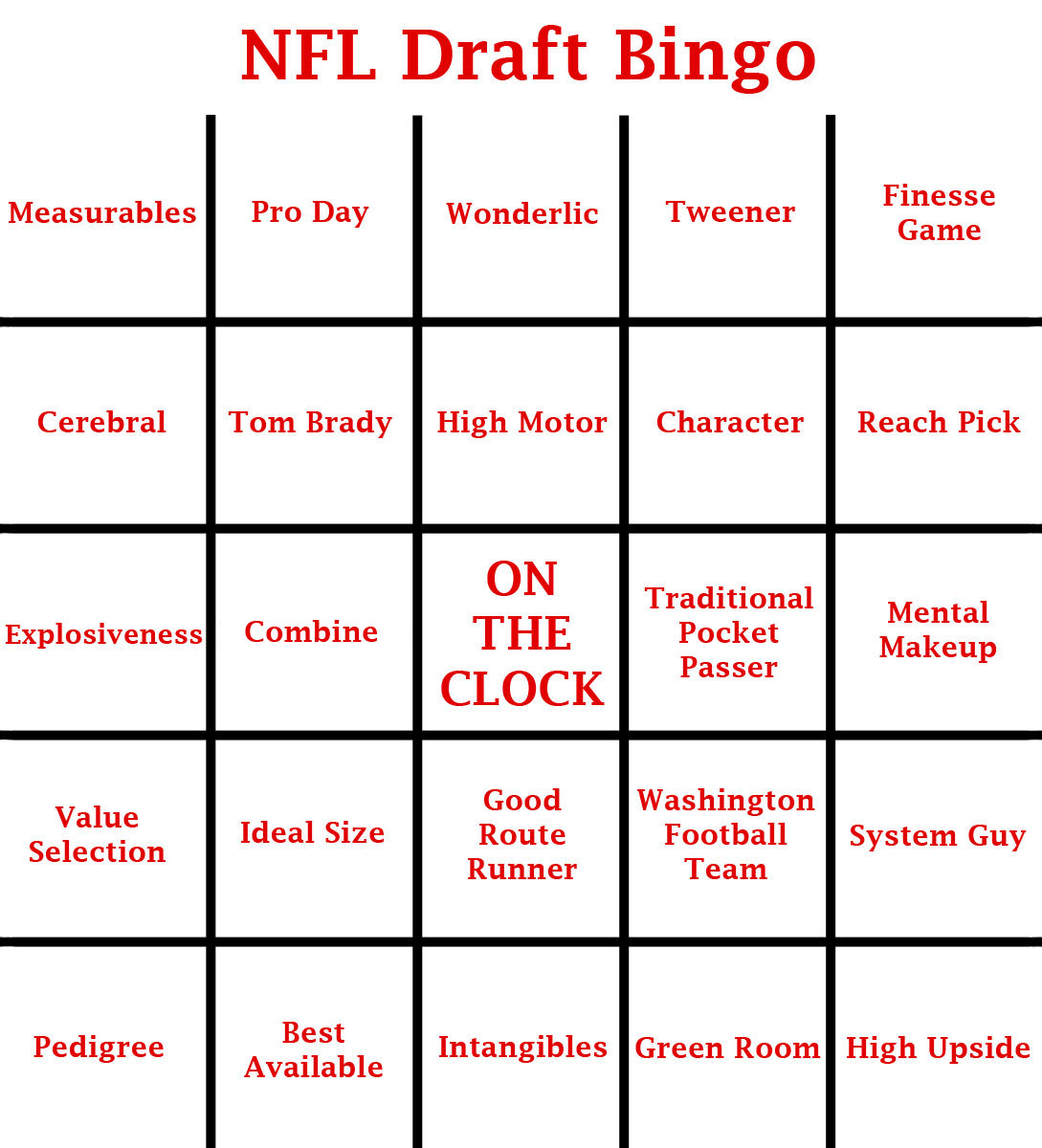
Measurables: Skills that can, somehow, be measured.
Pro Day: Workouts held prior to the draft at colleges.
Wonderlic: A test administered specifically to quarterbacks, intended to judge their decision-making ability.
Tweener: A player who doesn鈥檛 fit the 鈥渋deal size鈥� for his position and may have to learn a new position in the NFL.
Finesse Game: A quiet slight towards players perceived as soft.
Cerebral: A dumb person鈥檚 smart term for intelligence.
High Motor: The football equivalent of 鈥渉ustle鈥� from baseball.
Tom Brady: Every year, analysts will remind the viewer that Tom Brady wasn鈥檛 drafted until the sixth round. Literally every person still watching will already know this.
Character: Off-the-field behavior. See: Jameis Winston.
Reach Pick: A player the analysts believe to be drafted above his value.
Explosiveness: Quickness off the line of scrimmage.
Combine: The NFL workout day for potential draftees.
On the clock: Team that is next to pick.
Traditional Pocket Passer: A non-mobile quarterback who fits the prototype of signal callers from the past few decades.
Mental Makeup: Generic term for intelligence.
Value Selection: A player the analysts believe to be drafted below his value.
Ideal Size: The prescribed height for a certain position, according to the experts.
Good Route Runner: A wide receiver who puts himself in the precise spot the quarterback expects him, based on the play design.
Washington Football Team: The alternative term used as part of the . Check this box if any analyst refuses to use the nickname 鈥淩edskins.鈥�
System Guy: A player the analysts believe has shown the ability to play within a certain offensive or defensive scheme.
Pedigree: Genealogical lineage to former athletes.
Intangibles: Everything else.
Green Room: Area backstage completely unnecessary for an event like the NFL Draft.
High Upside: Perceived potential for improvement.


