
WASHINGTON — Maryland might have lost to West Virginia last weekend no matter who was on the floor. But losing their star point guard, Melo Trimble — after he took two shots to the head in the second half — certainly couldn鈥檛 have helped.
As the Terrapins faced a stiff challenge from the Mountaineers in the round of 32 of the NCAA Tournament, Trimble was ruled out by the medical staff and relegated to the bench for the remainder of the game, where he watched the Terrapins鈥� season come to an end.
The moment served as something of a flashpoint for local sports fans in the progression of concussion protocol and player safety. Trimble, arguably Maryland鈥檚 best player, was desperately needed in that particular game from a strategy standpoint. West Virginia鈥檚 trapping defense had completely disrupted the Terps鈥� attack, as they committed a ghastly 23 turnovers. Eight of those came from Dez Wells, more of a natural off-guard forced to take over at the point in Trimble鈥檚 absence.
The University of Maryland Student-Athlete Handbook at the top of its illness/injury reporting procedures. After explaining what constitutes a concussion and listing signs and symptoms, it unequivocally answers the question of what to do if a student-athlete believes he or she has sustained such an injury (emphasis theirs):
DON鈥橳 HIDE IT! REPORT IT IMMEDIATELY TO YOUR ATHLETIC TRAINER, TEAM PHYSICIAN, AND/OR COACH! Get checked out by your athletic trainer and/or team physician BEFORE returning to practice or a game. Take the appropriate time to recover. While your brain is healing, you are much more likely to have a repeat concussion which can cause severe and permanent brain damage.
When asked after the game about the two incidents involving Trimble, head coach Mark Turgeon explained the process the medical training staff went through on the sideline.
鈥淭he first time he hit his head, he was fine. He bounced up, everything was clear. No head, nothing. Evaluated by our physician, said he could go back in,鈥� Turgeon said.
鈥淭he second time he came out, he didn’t pass enough of the tests and his head was hurting. And so first time he was fine. Second time he got kicked in the head, I think. And they said he can’t come back.鈥�
It鈥檚 hard to imagine such a scenario taking place 10, or even five years ago. Awareness of head injuries has risen exponentially, with the tide of public opinion seeming to sway to the side of player safety over the outcome of the game.
Dr. Claudia Dal Molin is an assistant professor of medicine at Maryland who specializes in orthopedics and sports medicine, with a focus on concussion management. While she has not been directly involved with Trimble鈥檚 care, she has worked with university athletic teams before and has seen plenty of sports-related head injuries and supervised treatment for them.
鈥淚 definitely think that with more knowledge 鈥� and our knowledge is still extremely limited 鈥� more attention has been given,鈥� says Dr. Dal Molin. 鈥淢ore knowledge is readily out there than it was five years ago.鈥�
There is now NCAA concussion protocol in place, and the organization mandates that each school create and execute their own plan for such scenarios. But there鈥檚 a deeper issue in the diagnostic process when it comes to young players that makes the correct diagnosis that much more difficult. Much of the reporting is up to the student-athlete themselves, and because of the way we develop as human beings, they may not even be able to make a correct judgment call as to how hurt they may really be.
鈥淭he most frustrating thing is that there is a, very real, smaller section of students that don鈥檛 have good judgment, the ability to make good decisions based on the information in front of you,鈥� explains Dal Molin. 鈥淭he frontal lobe is responsible for this judgment, and that doesn鈥檛 develop fully until your mid-20s.鈥�
This makes correct diagnosis on the sideline that much more important for amateur athletes. While Trimble鈥檚 potential professional aspirations are certainly a consideration, it鈥檚 the many more student-athletes without such talent and opportunity who will benefit most from tighter protocol. , only 1.6 percent of college football players will be drafted by the NFL, and only 1.2 percent of men鈥檚 college by the NBA. The rest will have to make a living doing something else, and all would benefit from fully functioning brains.
Jesse Harper is the CEO of i1 Biometrics in Seattle, which is hoping to make strides with the development of a new that sends real-time data from head impacts to trainers and coaches. He says there鈥檚 been a 70 percent spike in head injuries in basketball over the past few years, but believes that鈥檚 a result of better reporting and awareness, not any change in the game itself.
鈥淚 wouldn鈥檛 say I was surprised,鈥� he says of Trimble鈥檚 removal from the game. 鈥淏ut it鈥檚 certainly something that 10 years ago you didn鈥檛 see
Unfortunately, it has taken tragedy to help raise more awareness of concussions at the amateur level. In December, an . It was later revealed that he had multiple concussions, leading to spells of extreme confusion.
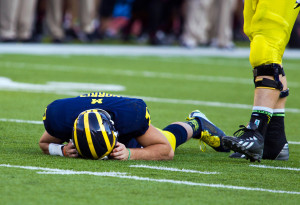
As recently as this past fall, college coaches have come under fire for putting players back into games when they display concussion-like symptoms. Head Michigan football coach Brady Hoke claimed ignorance as to the state of quarterback Shane Morris, who was left in a late September game despite . That caused widespread outrage and demands for Hoke to be fired from many voices, including (Hoke was eventually let go at the end of the season).
鈥淭he court of public opinion has weighed in and changed sides,鈥� says Harper. We saw it at Michigan. I鈥檓 not saying it鈥檚 why Hoke and the AD got canned, but it certainly didn鈥檛 help.鈥�
Just this week, due to the potential permanent brain damage that the multiple concussions he has already received might be exacerbated by continuing to play the game. That鈥檚 where Biometrics hopes to step in, trying to diagnose brain injuries and preventing players from returning to the field when they might make them worse. The company has entered into agreements with major college football programs including LSU, South Carolina and Texas A&M 聽to use their technology in practices and games starting this upcoming season.
鈥淲e can see not only how hard a player gets hit, but where on the head they get hit,鈥� Harper explains. That allows us to create a heat map over time, where we can review the entire exposure to head impacts over time.鈥�
That allows training staffs to set different thresholds for their players, depending on prior injury. The system allows alerts to be sent immediately anytime a hit crosses that threshold. On a larger scale, the aggregate data also has value across demographics to provide researchers with valuable new information on a field we still know very little about.
鈥淚n the physician and research community, we still don鈥檛 know long-term effects (of concussions)鈥� says Dal Molin. 鈥淭here are things that we can measure and do understand, but the majority of athletes still don鈥檛 understand the importance of education and treatment.鈥�


