
Millions of Americans will be able to see the on April 8, 2024, and chances are many will want to grab their phone and take pictures to document the rare event.
Experts warn that it’s essential not only to from the sun, but also to be cautious when using your phone to view or take photos of the .
A partial solar eclipse, when the moon blocks some of the sun, will occur from coast to coast, while a total solar eclipse —when the moon lines up with the sun, blocking all of its light — will be ¾±²ÔÌý stretching across , from Texas to Maine.
“There is no safe time to look at the sun without protection, period,” Dr. Christopher Starr, director of the fellowship program in cornea, cataract and laser vision correction surgery at NewYork-Presbyterian and Weill Cornell Medicine, with Health Matters, NewYork-Presbyterian’s online journal. “Not a split second, not a half a second, not a quarter of a second. At no time should a kid, or an adult, be looking at the sun even as the sun is partially eclipsed. It’s still unsafe.”
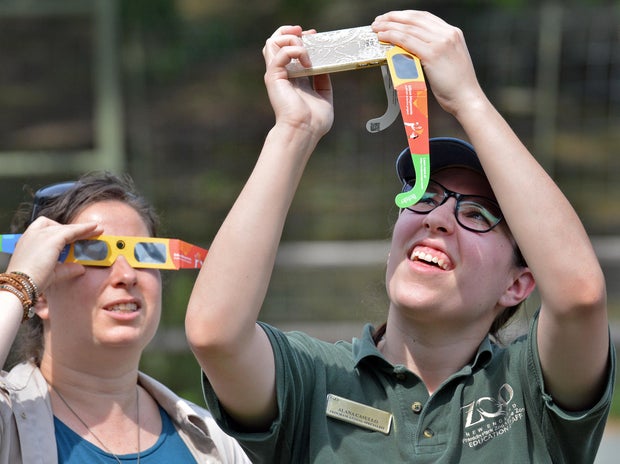
The to look at a partially eclipsed sun is with that meet an international standard, ISO 12312-2, according to the American Optometric Association.
Can I take pictures of the solar eclipse with my cellphone?
Cellphone cameras should not be pointed directly at the sun, as it may damage the phone’s sensor, experts say.
Smartphones were never designed for taking photos of the sun or the moon, according to NASA. Because standard lenses are very small, they aren’t equipped with the resolution needed for the largest objects in the sky like the sun and moon.
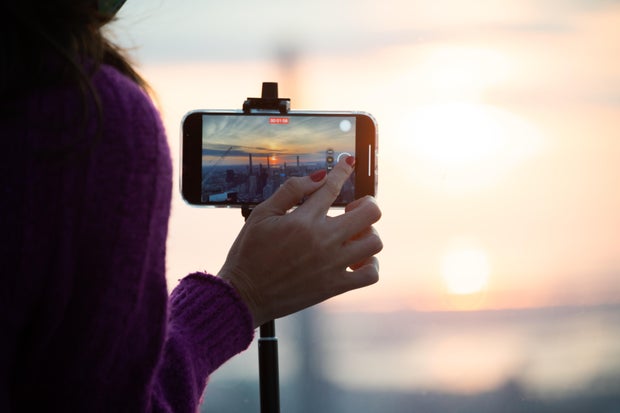
“Cellphone cameras do not have the kind of protective filters needed for safe or successful solar photography,” Dr. Geoff Bradford, professor of ophthalmology at West Virginia University, told CBS ²ÝÝ®´«Ã½.
Photographing the partial eclipse with a smartphone will likely not only damage the camera sensor but also result in an overexposed photo, Bradford said.
Douglas Goodwin, professor of media studies at Scripps College and an expert in computational photography, agreed.
“Smartphone cameras in 2024 have small sensors and lenses, making it challenging to capture detailed images of the eclipse itself,” Goodwin said in an interview. “Taking photos of an eclipse is even harder than taking photos of the moon — it’s small and dazzling!”
Can I look at the sun on my cellphone screen?
Pointing your cellphone at the sun is bad for the phone, but it also if you look at the sun on your cellphone screen, experts say.
Except for the , when the sun is completely obstructed, “viewing the sun with your unprotected eyes or through a cellphone screen is extremely dangerous,” Bradford said, advising that all visual contact with the sun take place only through special solar eclipse glasses that meet international standards.
That international safety standard, which is set by the , means the glasses reduce visible sunlight to a safe level and block ultraviolet and infrared radiation, according to the Ìý·É±ð²ú²õ¾±³Ù±ð.
Ultraviolet radiation can damage the eyes’s cells, while heat from infrared radiation can cause thermal damage, .
What’s the safest way of taking pictures of the eclipse?
The has various stages and effects, and some are safer to photograph than others.
“Smartphones will be great for capturing the experience of the eclipse,” Goodwin said. This includes the effects of the altered lighting around us.
“Keep your head down and look under leafy trees for crescent-shaped projections of the eclipsed sun on the ground,” Goodwin said. “Plus, you will observe how the strange light affects people and animals.”
Goodwin also recommended that people in the eclipse’s path look for shadow bands, which are mysterious gray ripples that snake over the ground just before and after the total eclipse.
If you really want to photograph the sun as it becomes partially covered, take an extra pair of solar eclipse glasses, cut them and tape one of the filters over your phone’s camera lens, Bradford said. If your smartphone has several lenses, make sure all are covered.
If you’re using an iPhone, you should turn off the camera’s when putting a filter in front of the camera.
“Do not look at the sun, even briefly, while pointing your camera skyward,” Bradford said. “To enlarge the eclipse further than your camera zoom will allow, you can purchase a clip-on zoom lens for your smartphone for more dramatic photos.”
Can I take photos of the sun when it’s fully obstructed?
If you’re in the , during the few minutes of total eclipse, you can look up without eye protection and take unfiltered photographs with a smartphone, Bradford said.
But it’s important to be mindful that the total eclipse is a fleeting occurrence. As soon as the moon begins to move away from the sun and sunlight reappears, make sure your eclipse glasses and camera filter are back on, Bradford advised.
Some looking up at the sun even when it’s fully obstructed because of how suddenly sunlight can reappear.
“Totality of the eclipse lasts only about 1 to 3 minutes based on geographic location, and bright sunlight suddenly can appear as the moon continues to move,” an eclipse viewing guide published ¾±²ÔÌýÂ noted, adding that “even a few seconds of viewing the sun during an eclipse” can temporarily or permanently damage your vision.
Looking at a partial eclipse without the protection of filters can cause permanent and irreversible eye damage, including blind spots, distorted vision and decreased color vision, Bradford said.
During the darkened few moments of the total eclipse, Goodwin recommends using your smartphone’s HDR (High Dynamic Range) and Night modes to enhance photographs. HDR mixes exposures to capture a range of brightness levels, while Night mode uses image stacking to create well-lit photos in low-light conditions, Goodwin said.
You can use the iPhone’s Wide and Ultra Wide cameras during near-total darkness.


